
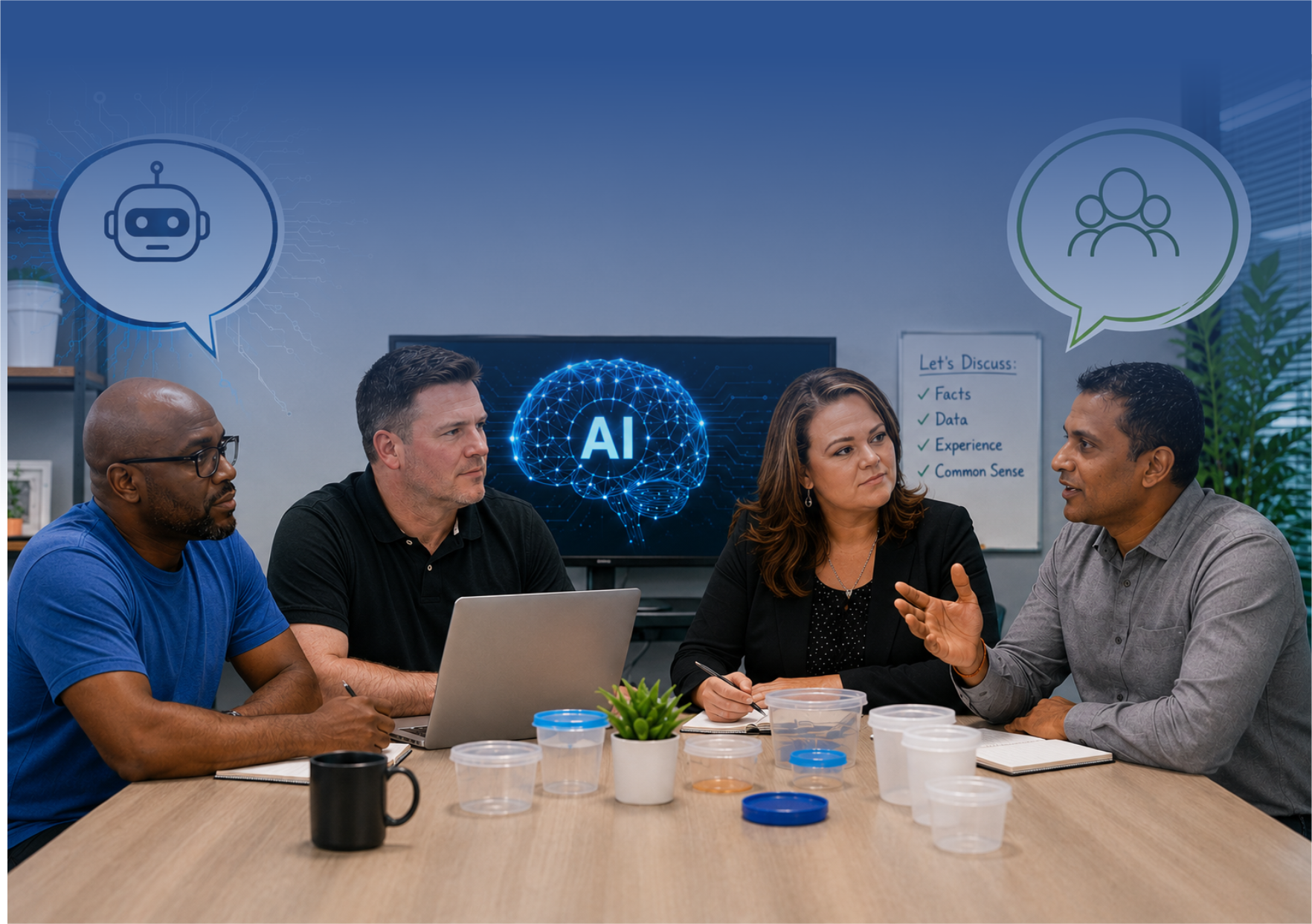
THE BIG DEBATE @ PLASTIC BUBBLES
Artificial Intelligence has become everyone’s new favourite “personal assistant”. It writes emails, creates social media posts, answers technical questions and even tells us how long to boil an egg. But there’s one small problem… Sometimes AI is confidently wrong.
The challenge isn’t that AI occasionally gets things wrong, humans do too. The real danger is when we stop checking the information we receive before sharing it with colleagues, customers or the public.
To see how AI misinformation spreads, we eavesdropped on a few coffee-break conversations to assess how easily this happens right here, at Plastic Bubbles (PB).
PB Coffee Break Chronicles
Casual conversation in the social area….
Marketing Junior:
I need to get ideas for my blog this month and came across a social media post:
‘Plastic takes one million years to decompose.’
Is that true?
Quality Control (QC) Manager:
Mmmmm (scratching head)….. Where did you read this?! Every plastic polymer material does not behave the same under different environmental conditions. If you are sharing facts like this – I think you better verify the source first.
Meanwhile, in the outdoor lunch area….
Admin clerk:
My AI assistant told me that one plastic factory burnt down yesterday because of one cigarette butt that was not put out properly. How terrible?
Technical Sales staff:
Did you check?
Admin clerk:
Well….. Err – It sounded believable.
Technical Sales staff:
I bet the same AI assistant will tell you that ‘chocolate is a healthy food option’!
Back in the canteen….
Production assistant:
I asked AI to suggest some things I could try to get the cycle time of the machine faster. It suggested I increase the temperature of the mould and double the pressure on the controls.
Toolroom technician:
Amazing! What did you do?
Production assistant:
I wasn’t too sure how much to increase the temperature so I went to my manager to ask. I’m still not sure if he was about to faint or fire me?
Toolroom technician:
Clearly AI has never had to work overtime to repair a mould!
And while waiting in the boardroom for a meeting to start….
Dispatch foreman:
AI is getting out of hand! My GPS navigation wanted me to drive through the river to get back to my hometown this weekend!
Everyone:
Exactly what it told me when I asked for the quickest route home!!!
The funny side of AI
Let’s be honest… AI can produce some hilarious results.
It confidently shares quotes from well-known celebrities.
It spits out recipes that include ingredients from chappie (sweet) wrappers.
It tells you to glue cheese onto pizza after baking.
It directs you to cities and roads that no one has heard of.
And yes… sometimes it creates images of sunsets under the sea.
Most of the time, these mistakes are amusing.
Until some friend on Facebook actually believes them.
When it becomes serious
Imagine publishing AI-generated information without checking it first.
A company shares incorrect recycling advice.
A salesperson quotes the wrong product specification.
A health article contains false medical advice.
A customer receives incorrect operating instructions.
A financial report includes fabricated statistics.
These aren’t just embarrassing, they can damage trust, reputations and even people’s safety.
The internet is already full of misinformation. AI can accidentally amplify it if users don’t stop to verify what they’re reading.
Marketing Team’s Question:
So…. should we stop using AI?
Financial Manager (FM):
Absolutely not.
Marketing:
Really?
FM:
AI is a tool. Just like a calculator.
A calculator can still give you the wrong answer if you type in the wrong numbers.
The Golden Rule
AI is brilliant at helping us:
- Generate ideas
- Improve writing
- Summarise information
- Speed up repetitive tasks
- Translate content
But it shouldn’t replace critical thinking.
If the information will be seen by customers, suppliers, colleagues or the public, ask yourself:
- Where did this information come from?
- Can I verify it?
- Does it sound logical?
- Would I be comfortable signing my name next to it?
If the answer is NO… Do your homework: double-check.
Final thought
Artificial Intelligence is changing the way we work and for the better. It helps us work faster, think differently and solve problems more efficiently.
But the most powerful processor in the room is still the one between our ears.
Use AI to assist your thinking, not to replace it.
Because the best results come from combining artificial intelligence with human judgement.
Admin Manager:
AI told me drinking coffee makes you live longer.
Operator:
Please can we have more coffee breaks?


